
REVIEW · LONDON CITY TOURS
Soho London Private Music Self-Guided Tour
Soho sounds different after this walk. This self-guided route uses Evren’s audio and in-app maps, so you can wander Soho at your own speed and start when it fits your day. It is built for learning while you walk, not for racing through.
I really like the mix of famous stages, studio legends, and street-level stops, plus the fact that you get 3 weeks of unlimited access to replay everything. The other thing I like is that the route is designed as a smooth GPS route, with clear directions and quick stops you can actually manage in about 2 hours. One drawback to note: it is self-guided, so there is no in-person guide for questions.
Key things that make this Soho music tour work
- Audio by Evren, not robotic narration that keeps the route feeling human and easy to follow
- 3 weeks of unlimited app access, so you can replay the stories when something sparks your interest
- A clear end point at Trident Audio Post, where you can wrap up and keep roaming Soho on your own
- Denmark Street as a real music timeline, linking studios, publishing, and the punk era to present-day landmarks
- Many stops are ticket-free, which is great if you want value without adding entry fees
- A flexible start time, so you can plan around your theater day or dinner plans
Why a self-guided Soho music walk fits London so well
Soho is one of those places where you can turn a normal stroll into something meaningful, fast. The streets are packed with names you already know, but it takes context to understand why those names are connected to these exact corners.
This tour leans into that idea. You are not waiting around for a group or a set departure time. Instead, you use the app for the route and you listen as you go. That matters, because in London you can have a tight schedule, and you still want your sightseeing to feel personal.
You can also read our reviews of more guided tours in London


Price and what you are really paying for
At about $12.47 per person for a 2-hour experience, you are paying for structure plus storytelling. You are not paying for a person standing next to you, because there is no in-person guide included. That is the trade.
The good news is you get value in a different way: 3 weeks unlimited access. If you want to hear the audio again after dinner, or you want to replay the parts about Denmark Street while you are still in the neighborhood, the app is there. For this kind of walking tour, repeat access is a big deal.
One more practical detail: you are not stuck with one start time. The tour lets you begin at a time that works for your schedule, which helps you avoid the stress of fitting everything into a rigid itinerary.
Getting going at Dominion Theatre, then ending at Trident Audio Post
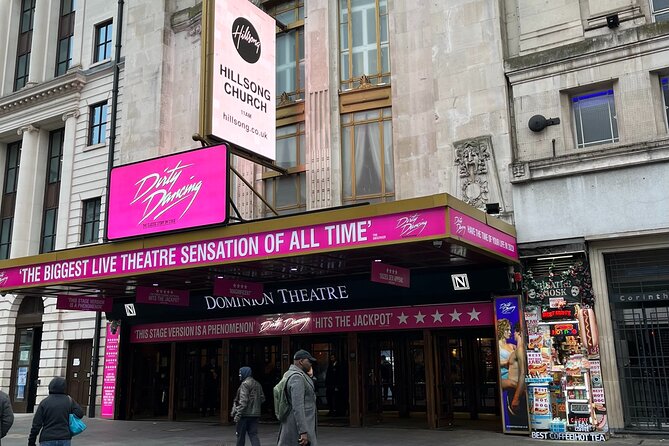
The route begins at Dominion Theatre, 268-269 Tottenham Ct Rd, London W1T 7AQ and ends at Trident Audio Post, 33 Great Pulteney St, London W1F 9NP. That end point is not just a random finish, it is a meaningful one. Trident is tied to recording history, and the tour uses that connection to close your loop on Soho’s music story.
It also helps that the experience runs daily, with hours listed as 12:00 AM to 11:30 PM across the date range shown. In plain terms, you can slot this into most days, including evenings, as long as the places you want to see are open.
Also, because it is a private tour/activity for your group, you are not sharing the pacing with strangers. With a self-guided format, that difference still feels real.
Using the app: GPS directions and a guided audio track
This is one of those tours where the tech is the backbone. The included materials cover map, directions, GPS route, plus an audio guide with audio, videos, pictures, and recommendations.
You will receive an email with instructions to activate the tour. The note that the booking reference is not your code is small, but it saves you from that annoying moment of trying to type the wrong thing into the app.
The audio is provided by Evren, and it is specifically noted as not computer-generated voice. That is a big plus for a walking experience. You want something that feels steady while you are stopping for street details and reading signage in motion.
Dominion Theatre and the West End stage that ties into music
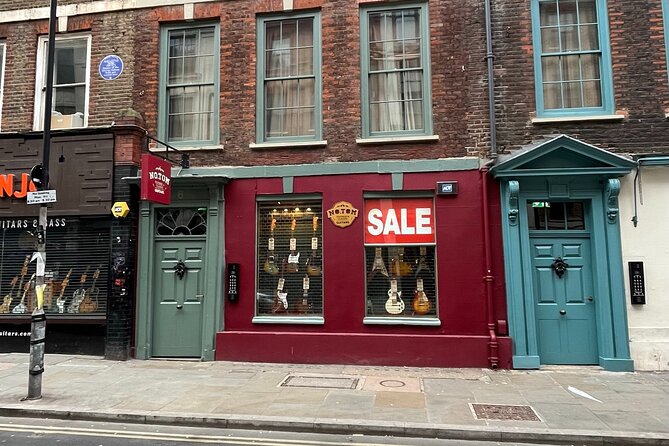
Your first stop is Dominion Theatre on Tottenham Court Road. This is a grand West End venue with a long list of musicals and concerts. The tour links it to a landmark performance by David Bowie, which gives you a quick anchor right at the start.
What I like about beginning with a theater like this is that it frames Soho the right way. You are not just chasing rock and roll facts. You are seeing that Soho music culture includes stage performances, big-name events, and mainstream entertainment, all sitting next to small street history.
You can also read our reviews of more private tours in London




Astoria Theatre: where music happened, even after closure
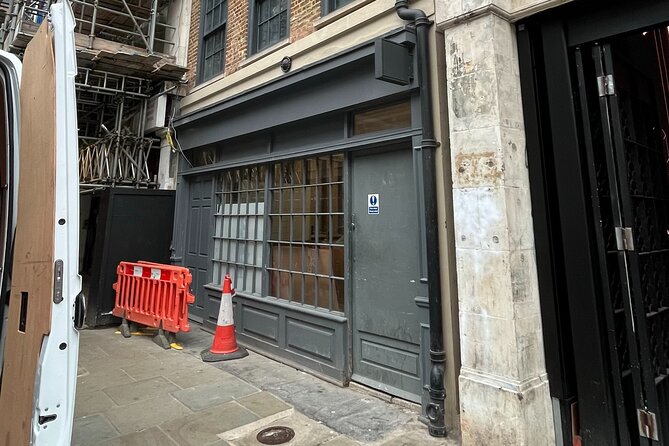
Next up is the former Astoria Theatre site. The key point here is the contrast between past and present. The Astoria hosted many noteworthy bands and artists, and even though it is closed now, the tour treats it as a part of Soho’s ongoing music identity.
This stop is useful because it trains your eye for what is still visible and what is not. In Soho, a lot of music history lives in buildings you can no longer enter. That is normal here. The tour helps you make peace with it by connecting the dots.
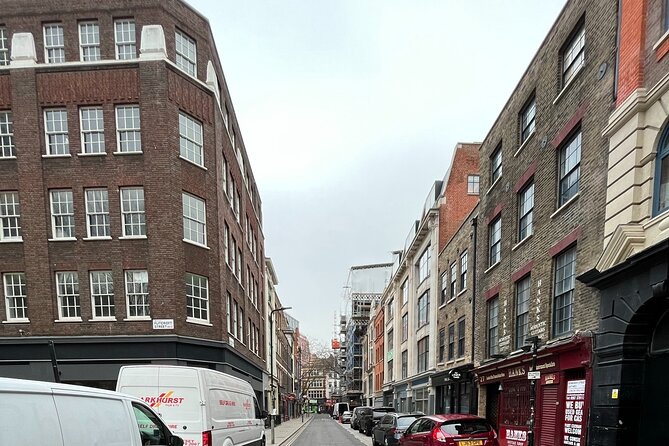
Denmark Street, the UK’s Tin Pan Alley, and why it matters
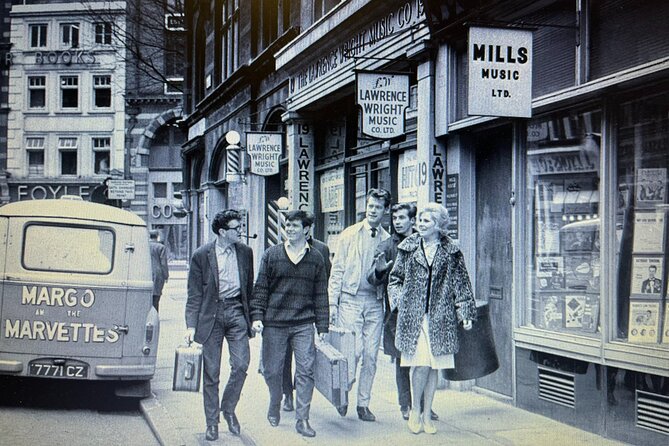
Now you hit Denmark Street, and the tour explains why it is often called the British Tin Pan Alley. This is where many world-famous songs were written, and where artists like Elton John and the Rolling Stones started their careers in recording studios.
This is the heart of the route for anyone who wants the music business story, not only the performance story. Denmark Street ties songwriting, recording, and publishing into one recognizable zone. When you understand that flow, you start noticing different types of music power around you.
You also get a nice momentum boost here. The tour includes a sequence of stops that feel like stepping stones through eras, from mainstream beginnings to punk and beyond.
Inside the Denmark Street loop: studios, pubs, publishing, and punk corners
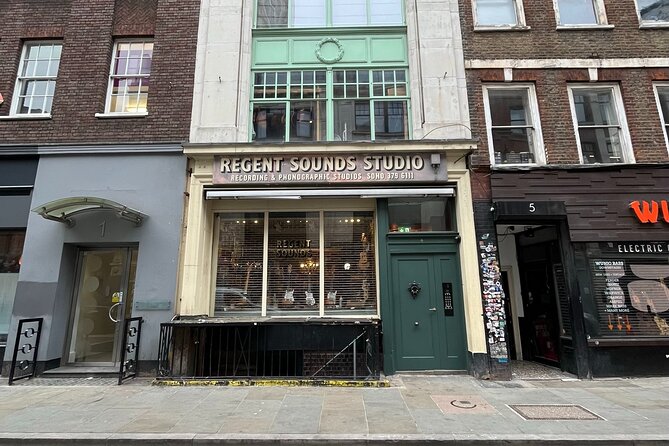
From Denmark Street, you move through several spots that each teach a different angle.
First is the 12 Bar Club, known for grassroots music and early performances by artists like Adele and The Libertines. The lesson here is that big careers often start in rooms that feel almost too small for fame.
Then you reach Regent Sounds Studio, a legendary recording space where iconic records were made. It is tied to the Rolling Stones first album and to sessions by The Beatles. Today it is a guitar shop, and that transition is part of the charm. You are seeing the neighborhood evolve while still carrying the sound forward.
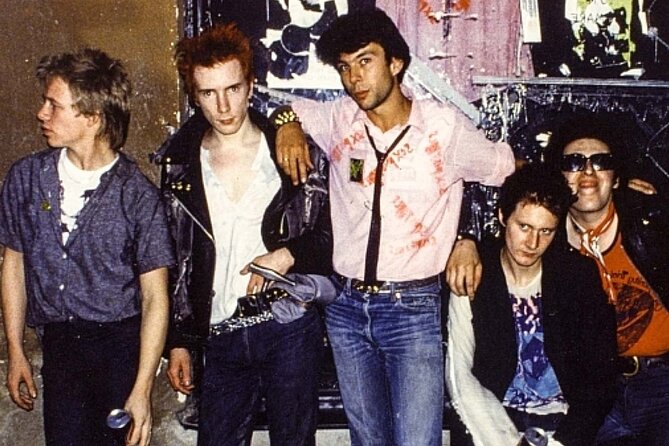
The stop at No. 6 Denmark Street points to punk history. It connects to where the Sex Pistols lived and recorded in the 1970s. This is one of the more direct attitude stops on the route, and it gives your walk a clear emotional shift from polished studio lore into rebellion and urgency.
Next is Mills Music, a major music publishing company on Denmark Street. The tour highlights its early 20th-century roots and its role in shaping British popular music, plus connections to Jimmy Page and David Bowie. If you care about the business side, this is where your brain clicks. Publishing is not as loud as a studio session, but it is where songs gain traction.
You also stop at La Giaconda, described as a legendary café and a hangout spot for musicians and songwriters in the 1960s. The tour names David Bowie, Jimi Hendrix, and Elton John as frequent visitors. Even if you only glance at the storefront, this kind of stop helps you picture the social side of music, not just the recordings.
Then comes KPM Music House, part of the historic KPM Music House complex. The tour points out its extensive catalogue and emphasizes the part of the industry that often stays off the public radar, music publishing tied to film and television. It is a smart inclusion, because it widens your view beyond guitars and stage lights.
Forbidden Planet and Phoenix Theatre: culture detour done right
At Forbidden Planet, the tour shifts into Soho’s broader pop-culture vibe. It is described as the world’s largest and best-known comic, science fiction, fantasy, and cult entertainment retailer. This stop is short, but it matters because Soho is not only about one genre of music. It is about creative identity in general.
Next is the Phoenix Theatre, a well-known West End venue. The tour mentions that David Cassidy performed in Blood Brothers there, tying pop stardom back into the theatrical stage.
This segment works well because it gives your ears a break while keeping the theme of performance. You are still in the orbit of artists and audiences, just through a different doorway.
Phoenix Gardens and Odeon Covent Garden: a pause and a musical rewind
You then get a breather at Phoenix Garden, described as a community garden and a quiet pocket amid Soho streets. Not everything on the route is strictly about recording or songwriting, and that is okay. This pause gives your brain room to absorb the loud parts.
From there, you move to Odeon Covent Garden, formerly Saville Theatre. The tour notes iconic musical performances in the 1960s, including those by The Beatles and Jimi Hendrix, plus management by Brian Epstein. Again, it is a helpful lesson in how Soho connects to the wider West End machine.
Macaris Guitar Shop, Foyles, and why these are more than quick stops
Next is Macaris Guitar Shop, now an Apple Store. The tour frames Macaris as a beloved institution in Soho’s music scene, known for supplying instruments to aspiring musicians and stars. Even though the use of the storefront has changed, the tour points out that the musical spirit remains in the neighborhood.
Right after that you stop at Foyles Book Shop. It is not a direct music venue, but it is a creative and intellectual landmark. The tour highlights that Foyles has an extensive music section with scores, biographies, and history books, which makes it a practical bonus if you want to keep learning after your walk.
If you have ever left a music-focused walk thinking, I want more, this is the kind of stop that turns curiosity into a next step.
When venues close: Borderline Nightclub and the story of what’s gone
The route includes The Borderline Nightclub, but it is listed as currently closed. The tour still gives it attention because it was known for an eclectic mix of artists, and it left an imprint on Soho nightlife.
This part can feel bittersweet, but it is also honest. Soho music culture changes. Clubs close. Buildings shift uses. The value is in learning what happened there, even if you cannot step inside anymore.
Soho Square, Dog and Duck, and a Mozart plaque that sneaks music farther back
At Soho Square, you get one of London’s older squares plus a strong music connection. The tour notes it is overlooked by a building owned by Paul McCartney and that it has witnessed secret performances, including two by Prince in one night. That is the kind of detail that makes a simple open space feel like part of a story.
You also stop at The Dog and Duck, a historic English pub. The tour says the direct ties to music are subtler, but it is a classic Soho landmark and a good place for a traditional pub pause while you absorb what you just learned.
Then the route hits Mozart Blue Plaque. It marks the residence where Wolfgang Amadeus Mozart, aged eight, composed his first symphony in 1764. This stop expands the scope beyond modern rock and jazz and reminds you that London music culture goes way back.
Ronnie Scott’s Jazz Club and the legacy stops that turn into landmarks
Next is Ronnie Scott’s Jazz Club, a major jazz venue since 1959. The tour points out that it hosted performances from many notable jazz artists, including Miles Davis, Ella Fitzgerald, and Nina Simone. This is a stop that works on two levels: music fans get the names, and non-fans get the sense of gravity.
The tour also includes 2i’s Coffee Bar, described as the birthplace of British rock ‘n’ roll and a hub for emerging talent in the 1950s and 1960s. It ties the story to artists discovered there, including Cliff Richard and Tommy Steele. The note that it is no longer standing matters, because it means you are learning from location memory.
Then you reach the Marquee Club, described as once leading a London music scene and tied to debut performances by the Rolling Stones and The Who. It is listed as closed, but the tour treats its history as still part of Soho’s music map.
These legacy stops are actually some of the most powerful parts of the tour. You start seeing that Soho music culture is not only a list of addresses, it is a chain of scenes that keep moving.
Reckless Records and Trident Studios: finishing with music you can take home
The tour ends with two great final notes.
First is Reckless Records, an independent record shop known for second-hand vinyl, CDs, and DVDs. If you want to translate what you heard into a physical memory, this is where you do it. Bring a short wish list, not an open-ended budget, because record shops can drain time in the best possible way.
Finally, you finish at Trident Audio Post, which connects to Trident Studios. The tour describes it as a legendary recording studio, with connections to albums including David Bowie’s Hunky Dory and Beatles recordings. It frames Trident as a creative hub where artists crafted timeless music.
Ending here makes your route feel complete. You start at a major theater and finish at a major studio story, then you can roam from there with more context than when you began.
How to get the most out of this walk (without slowing down your day)
A self-guided tour can go two ways: either you listen and look, or you multitask and miss the point. To keep it rewarding, I suggest these small habits.
Give yourself permission to stop for 30 to 60 seconds at each major corner. Many of the best details are in the connections, not in the building itself. Denmark Street is the classic example. If you only glance at storefronts, you lose the Tin Pan Alley timeline.
Also, plan for a rhythm. You have a sequence of stops, some quick, some longer in story. If you hit every stop back-to-back with no pause, your brain will feel overloaded. Use the quiet break at Phoenix Gardens as your reset if you want an easy mental tempo adjustment.
And if you are a music listener who likes names, consider doing a quick pre-game. Pick one era you care about most, punk or jazz or rock beginnings. Then let the audio nudge you through the rest.
Who should book this Soho private music self-guided tour
This tour is a great fit if you:
- Want a music-focused walk in central London without a guided group pace
- Like learning why famous songs and artists connect to real places
- Prefer to start on your schedule, since you can begin when it suits you
- Want repeat access so you can refresh the story later in your trip or after
It is also a good option if you travel with someone who enjoys planning, but you still want flexibility. And because the experience is private for your group, it can feel easier to manage than big mixed groups.
Should you book it?
Book this tour if you want Soho music history with practical flow. For the price, you get a structured route, GPS help, and an audio guide by Evren, plus the ability to replay everything for three weeks. That repeat access is where the value really stacks up.
Skip it, or at least pair it with other plans, if you need live answers and real-time interaction. There is no in-person guide. You are the guide, using the app and audio.
If your idea of a great London day is listening to the city while you walk, this is a smart way to turn Soho streets into a music timeline.
FAQ
How long does the Soho London Private Music Self-Guided Tour take?
The tour is listed as about 2 hours.
Where does the tour start and where does it end?
It starts at Dominion Theatre on Tottenham Court Road and ends at Trident Audio Post on Great Pulteney Street.
Can I start the tour at a time that works for my schedule?
Yes. The tour highlights that you can start at a time that is convenient for your plans.
Do I get GPS directions and maps?
Yes. The included details say the app provides map, directions, and a GPS route.
Who provides the audio guide?
The audio guide is provided by Evren, and it is described as not computer-generated voice.
Is there an in-person guide during the experience?
No. This is self-guided, and the listing specifies that an in-person guide is not included.
What language is the tour offered in?
The tour is offered in English.
Are the stops free to visit?
Many stops are marked with ticket-free admission in the tour information. Still, it is smart to use the Before You Go section on your ticket and check local status for each place.
Is it refundable if I cancel?
No. The experience is non-refundable and cannot be changed for any reason.
Is it accessible for most travelers, and can service animals join?
The listing says most travelers can participate, and service animals are allowed. It is also near public transportation.
More Guided Tours in London
More Tours in London




More Tour Reviews in London


Not for you? Here's more nearby things to do in London we have reviewed







More London City Tours worth a look.
 ★ 4.6The London Eye Entry TicketTickets from $3935,875 guest reviews
 ★ 4.7From London: Harry Potter Warner Bros Studio TourTickets from $11726,588 guest reviews
Westminster to Greenwich River Thames CruiseTickets from $2222,836 guest reviews
Magical London: Harry Potter Guided Walking TourTickets from $2022,044 guest reviews
 ★ 4.6Madame Tussauds LondonTickets from $3620,915 guest reviews
 ★ 4.5Stonehenge, Windsor Castle, and Bath from LondonTickets from $11118,662 guest reviews
 ★ 4.7Warner Bros. Studio Tour with TransfersTickets from $14417,586 guest reviews
 ★ 4.7Tower Bridge Entry TicketTickets from $2115,560 guest reviews
Continue by place or experience